Solid vs. Engineered Hardwood: How to Choose for Your Michigan Home
Both offer a real wood surface. The right choice starts with your room, subfloor, indoor conditions, and plans for the floor over time.
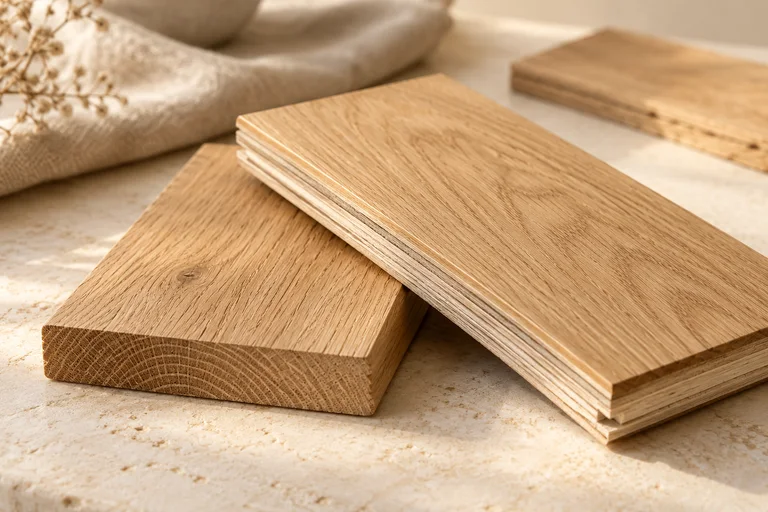
A main-floor living room over a wood subfloor and a finished basement over concrete can call for different products, even when you want the same oak appearance.
For a Michigan home, the useful questions are straightforward: Where will the floor go? What is underneath it? How will indoor humidity be managed? And how important is future sanding and refinishing? Those answers do more to narrow the choice than the words “solid” or “engineered” alone.
What is the difference?
Solid hardwood is milled from one piece of wood. Engineered hardwood has a real wood surface bonded to a layered core. Core construction varies by product. Engineered hardwood is different from laminate, which uses a decorative image rather than a real wood wear surface.
Engineered construction generally reduces expansion and contraction compared with solid wood. Both are real wood flooring options, and both need suitable indoor conditions. NWFA guide to wood flooring types
Solid hardwood
One piece of wood throughout the board.
Engineered hardwood
A real wood surface over a layered core.
Schematic, not to scale. Construction varies by product. Wear-layer thickness and total board thickness are different specifications.
Keep in mind“Choose hardwood construction around the room first, then compare the boards you like.”
Solid and engineered hardwood at a glance
| Decision | Solid hardwood | Engineered hardwood |
|---|---|---|
| Construction | One piece of wood | Real wood surface over a layered core |
| Seasonal movement | Generally more movement as moisture conditions change | Generally more dimensionally stable, with product differences |
| Typical locations | On or above grade, subject to product instructions | Some products approved on, above, or below grade |
| Future sanding | Often offers substantial refinishing potential; remaining usable wood matters | Depends on wear-layer thickness, condition, and manufacturer guidance |
| Installation | Approved fastening or adhesive method depends on product and substrate | May allow nail-down, glue-down, or floating installation; verify the exact product |
| Water exposure | Needs protection from excess moisture | “Engineered” does not mean waterproof |
This comparison is a starting point. Installation instructions and the actual condition of your home determine whether a particular product is suitable.
Start with the room and subfloor
Main-floor living spaces and bedrooms
When the room and subfloor meet product requirements, either construction may be a candidate. Ask the installer to assess the existing surface, moisture, flatness, floor height, and transitions before you commit to material.
If new flooring will meet existing hardwood, bring that detail into the decision early. Board width, thickness, species, and edge profile all deserve attention; a similar stain color alone does not establish a close match.
Basements and concrete slabs
Treat a basement as a separate installation question. A walkout door does not necessarily make the floor above grade. Many engineered products permit below-grade installation, but the exact floor, adhesive or underlayment, and moisture-control requirements must be checked together.
Concrete needs appropriate moisture testing even when it looks dry. An engineered product does not fix water intrusion or a persistently damp basement. Resolve those conditions before choosing flooring. Example manufacturer installation requirements
Rooms with frequent water exposure
Think carefully about full bathrooms, laundry areas, and entrances where wet footwear collects. Look up the product’s allowed locations and water-related exclusions. A general claim about engineered hardwood should never replace those details.
Plan for Michigan’s indoor conditions
Heating-season dryness and more humid periods make indoor moisture control part of the purchase decision. Wood exchanges moisture with its surroundings, so both the installation conditions and the conditions maintained afterward matter.
Our Michigan winter floor-care guide explains how to build a seasonal care routine.
Ask what temperature and relative-humidity range the selected product requires, how it will be measured, and whether your home can maintain it. Have the contractor explain acclimation or conditioning for that floor. A fixed number of days in unopened boxes is not a universal readiness test.
If you have radiant heat, verify approval for the specific flooring and heating system before ordering. Do not assume every engineered product qualifies. NWFA installation guidelines
Look closely at the wear layer
For engineered hardwood, total plank thickness and wear-layer thickness answer different questions. The wear layer is the real wood face layer above the core. Its full thickness is not necessarily available for sanding, and a thick overall board does not automatically have a thick wear layer.
Ask for the wear-layer specification and the manufacturer’s refinishing guidance. Some engineered products can be sanded and refinished; others have limited or no full-sanding potential. The remaining surface, previous sanding, texture, and condition need professional assessment.
Solid hardwood also has a limit. Its full board thickness is not all available for sanding, and prior refinishing affects what remains. Avoid buying either category based on a promised number of future sandings without product-specific support. Bruce hardwood FAQs and NWFA refinishing guidance
Compare everyday performance separately
“Solid” and “engineered” describe construction, not a scratch-proof finish. For an active household, compare the surface species, finish, maintenance instructions, and repair options for the actual products under consideration.
Dents and finish scratches are different forms of damage. A wood-hardness rating does not answer every question about surface wear, and a species rating for solid wood should not be treated as a complete rating for an engineered assembly. NWFA durability guidance
Also distinguish construction from finish location. Factory-finished flooring arrives with its finish applied; site-finished flooring is finished in the home. That choice affects customization and the installation schedule, including any finish-drying restrictions. NWFA finish guide
Compare complete estimates
Ask for comparable scopes rather than comparing carton prices alone. Confirm whether each estimate includes removal, subfloor preparation, moisture-related work, installation materials, trim, transitions, and any site finishing.
Bring samples into the rooms where you plan to install them. Look at several boards, their edges, and their variation in daylight and evening light. Then compare those visual preferences with the technical requirements and your budget.
Bring these questions to your estimate:
- Is this exact product approved for my room and subfloor?
- What moisture testing and preparation are required?
- What indoor conditions must I maintain?
- What is the wear-layer specification and refinishing guidance?
- How will transitions, stairs, and existing flooring be handled?
- What does the installed estimate include?
Frequently asked questions
Is engineered hardwood real wood?
Yes. Engineered hardwood has a real wood surface over a layered core. Ask to see a cross-section and the product specifications if the terminology on a sample is unclear.
Is engineered hardwood always better for Michigan homes?
No single construction fits every project. Engineered stability can be useful, while solid wood may suit a compatible room and long-term refinishing priorities. Evaluate the actual product and site conditions together.
Can engineered hardwood be installed in any basement?
No. The product must allow the installation, and the basement must meet moisture and other site requirements. Neither construction is a remedy for leaks or flooding.
Choose a floor that fits your home
Planning hardwood flooring in Grand Rapids or West Michigan? Explore Kingstree Flooring’s services, then request an estimate or call 616-414-2412. Share the rooms, existing flooring, subfloor if known, and what matters most to you so the material decision can start with your home’s needs.